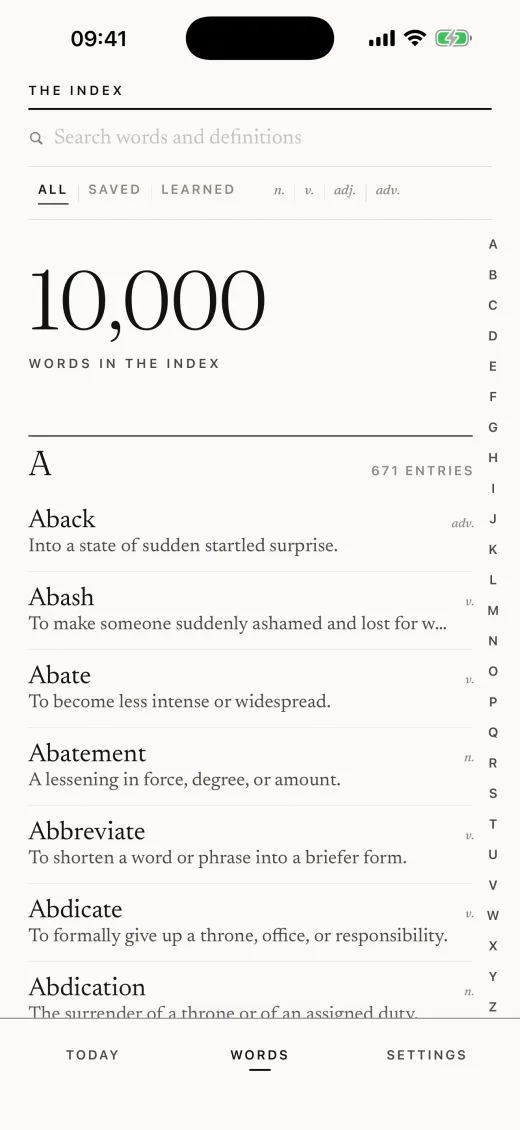
10,000
entries
27.4
years of mornings
21,053
example sentences
479
with an origin note
What it is
One word each morning, and a dictionary behind it.
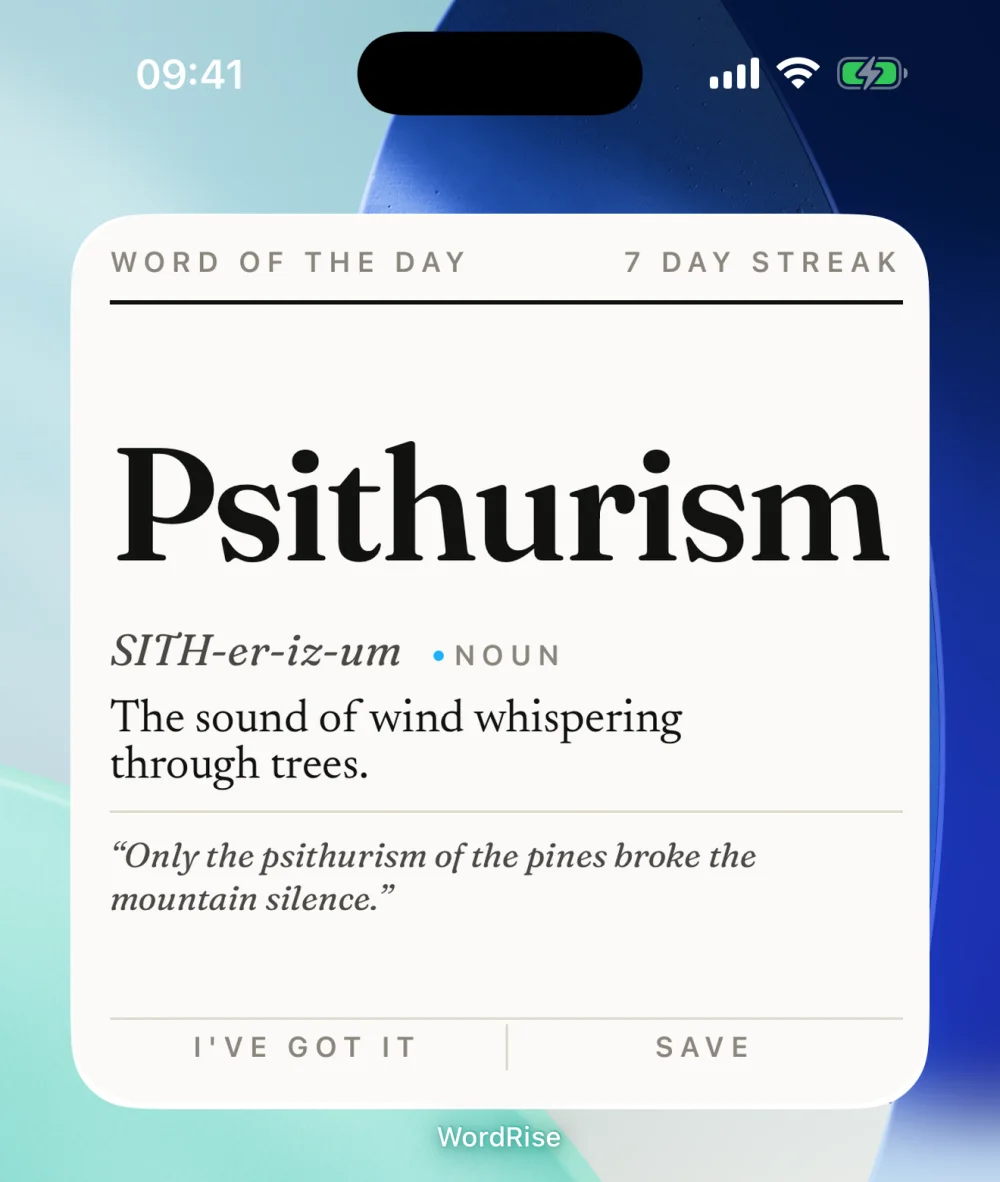
WordRise puts a single advanced English word on your home screen every morning, on a widget large enough to carry the whole definition and an example rather than hiding them behind a tap. The same word arrives as a notification if you want one. Behind it sits a 10,000-entry dictionary you can browse, search and keep.
The sequence is a curriculum rather than a shuffle. Entries are served rarest first, with the curated ones leading, so the first morning is Apricity instead of whatever a permutation produced. At one word a day the catalog runs 27.4 years.
The app
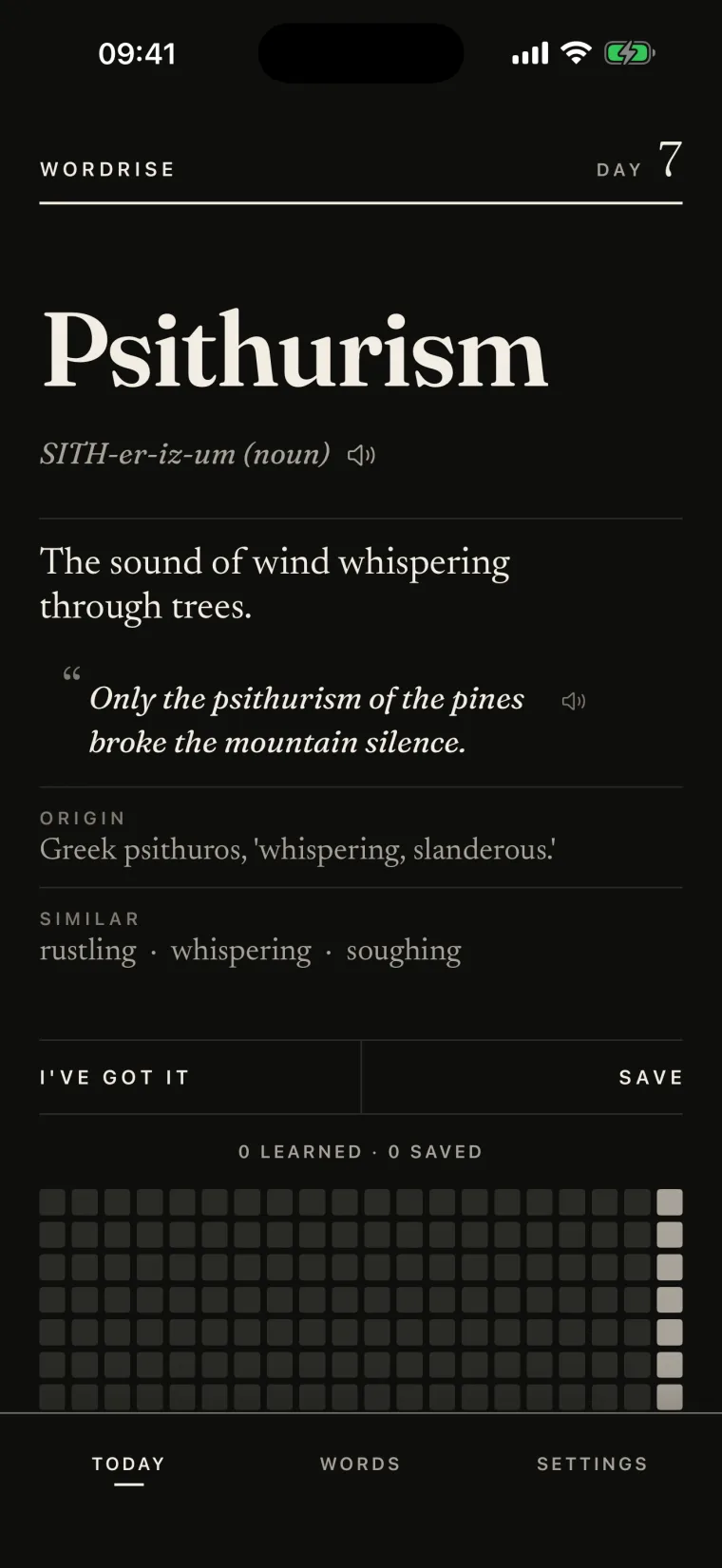
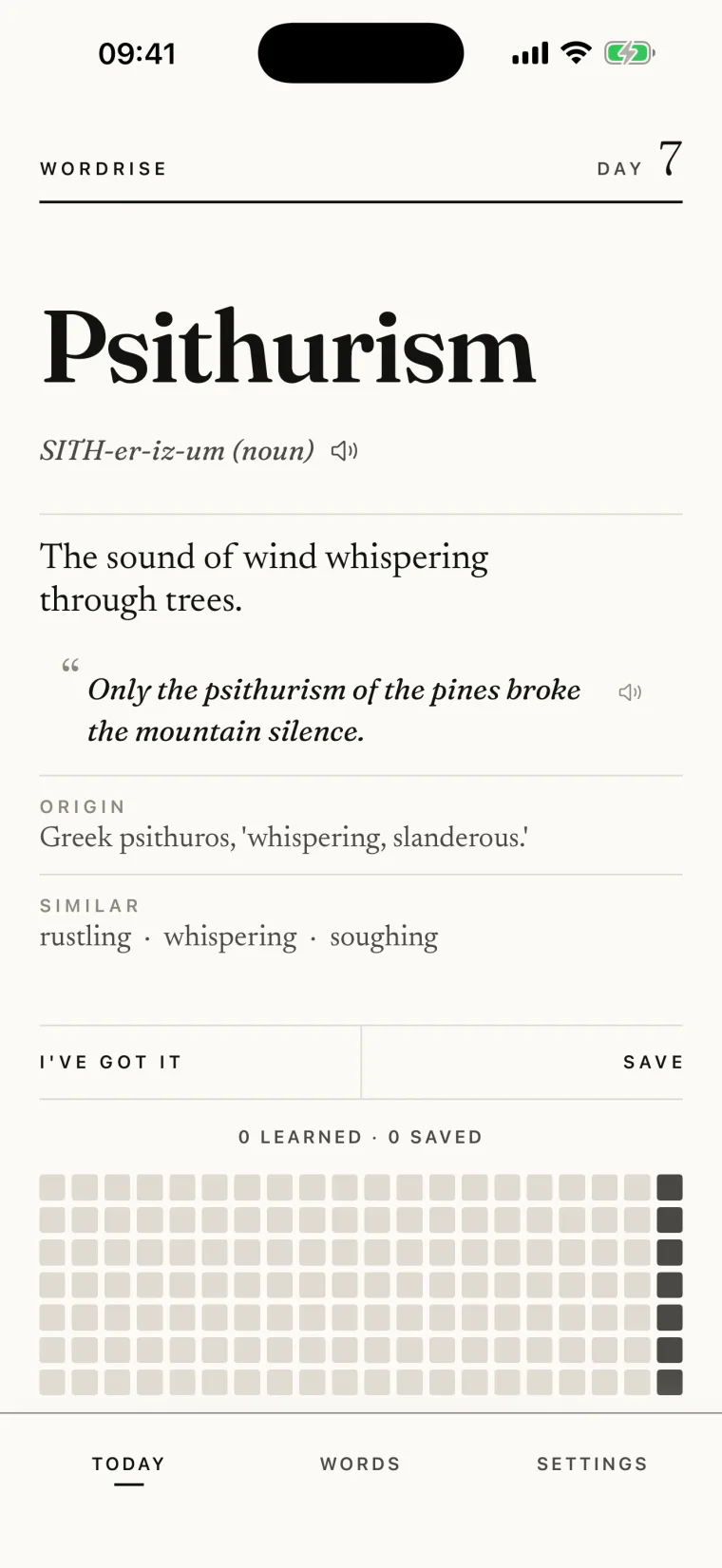
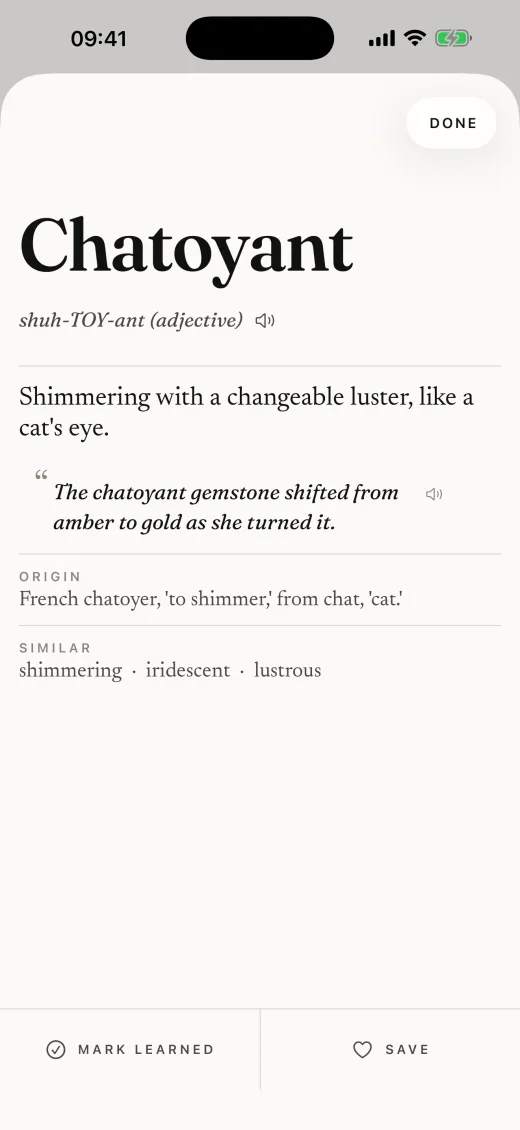
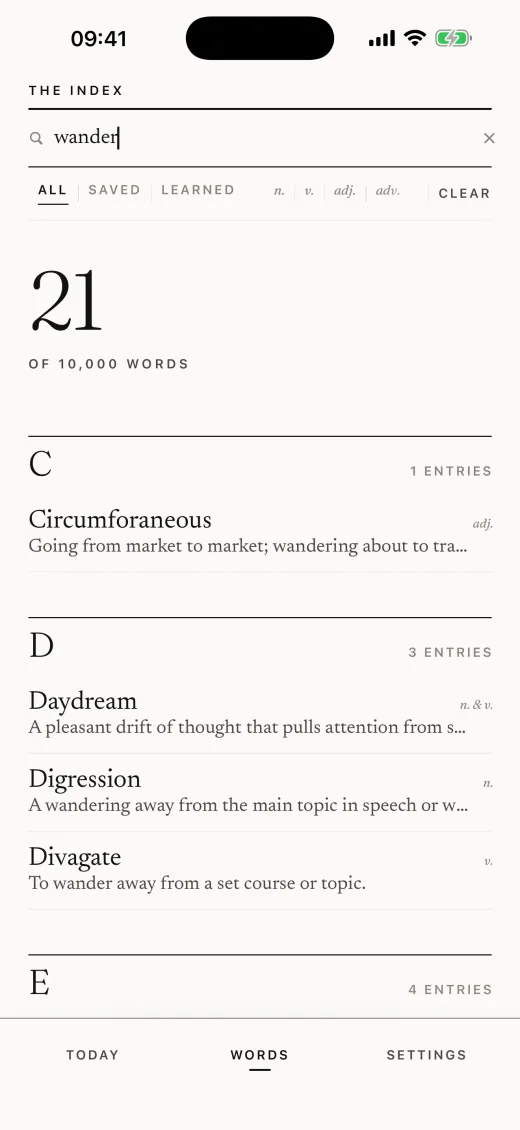
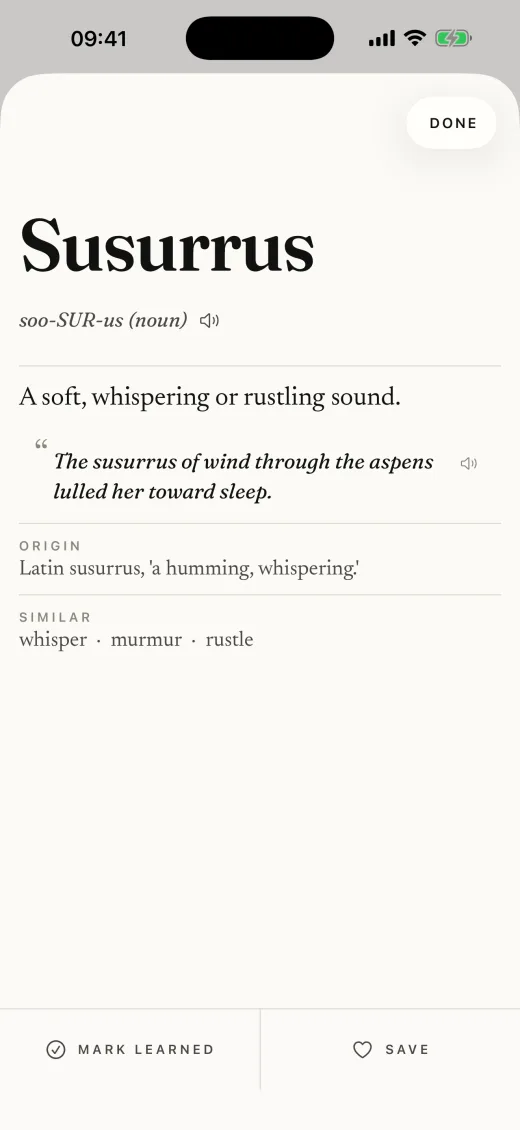
The same morning, in the dark and in the light.
WordRise has no appearance switch of its own. It follows whatever your iPhone is set to, which is why the page below is one page rather than two.
How it works
Entirely offline, with nothing to sign in to.
There is no account, no sign-in, no server, no analytics and no third-party code of any kind. The catalog and all 10,000 spoken headwords ship inside the app, so it works in airplane mode from the first launch. Two things ever touch the network, and both talk to Apple rather than to us: buying Full Access, and the optional download of the example-sentence recordings.
Your saved words, your learned words and your streak are stored on your iPhone and nowhere else. We never receive your reading history.
Where the words come from
A frequency floor, then a dictionary as the gate.
- The floor. Everything inside the 25,000 most common English words was cut, so an entry has to be genuinely uncommon to appear at all.
- The gate. Every proposed headword had to appear in Webster’s Second, a 236,000-entry dictionary, which is the check against a word that was invented rather than remembered.
- The curated 479. Written for WordRise and the only entries carrying an etymology.
- The rest. Built on WordNet 3.0 and the Carnegie Mellon Pronouncing Dictionary, used under their own licences, with the full text included in the app.
What it costs
Free every morning. One payment for the rest.
Free, permanently
- The word of the day, drawn from the whole catalog rather than a smaller pool.
- The widget, in four sizes, including the lock screen.
- The morning notification and the reading streak.
- All 10,000 headwords spoken aloud, offline.
- A 100-word Library sample, plus every word you have been shown.
Full Access · $9.99
- Every remaining entry in the index.
- Recorded audio for all 21,053 example sentences, as an optional download.
- One payment. Nothing renews, nothing lapses, nothing to cancel.
The limit sits on the Library, never on the morning. A word-of-the-day app’s scarce resource is time, not catalog size, so the day’s word is always drawn from all 10,000. Any word you have been shown stays yours to return to, whether you read it in the app, on the widget or in a notification.